Despite the importance of global competence education for young people in the 21st century, only limited research has been conducted on virtual exchange and global competence development among K-12 students to date. Through a recent study by AFS Intercultural Programs, a global non-profit specializing in intercultural learning programs, virtual exchanges can indeed have a meaningful impact on the development of global competence among 14- to 17-year-olds.  Data for the study were drawn from pre- and post-test surveys as well as from the students’ written responses from selected sections of the program’s online platform. The study, funded by the Stevens Initiative, formed part of the larger Strengthening the Field: Catalyzing Research in Virtual Exchange project. From April to October 2021, over 113 high school students from 35 countries participated in the AFS Global You Adventurer (GYA). This five-week virtual exchange program focused on global competence, with an online platform containing asynchronous activities and live facilitated dialogue sessions with qualified intercultural facilitators.
From recruitment to completion, AFS centered diversity and equity. Students in each group were drawn from diverse countries and backgrounds. Diverse perspectives were represented and honored throughout the content, and the qualified facilitators held brave space for learning. The program offered live sessions at various times to accommodate multiple time zones. The program platform complied with international accessibility standards such as WCAG 2.0 (1) to provide a more inclusive online learning experience. AFS recruited learners from underrepresented communities through teachers in underserved communities and schools. Students in the study included a range from paying program participants to fully sponsored.
The primary goal of this research was to identify and further develop the efficacy of virtual exchange, with the aim of strengthening programs by measuring the impact it has on high school students’ global competence development.
The Impact of Virtual Exchange
The results of the study suggest that short virtual exchanges, such as the five-week GYA, provide immediate growth in aspects of global competence, especially in terms of having a more positive view of peers from other cultures, being able to actively withhold judgment of others by staying curious and open-minded, and increased cross-cultural communication skills.
The Intercultural Effectiveness Scale (IES), developed by the Kozai Group, has been widely used to study the kinds of competence AFS was targeting in the GYA program. Using T-test comparisons of pre- and post-test scores on its 10 scales, the study found that the GYA participants significantly grew more than the control group in the Overall Scale, in “Positive Regard” and in “Self-Awareness.”
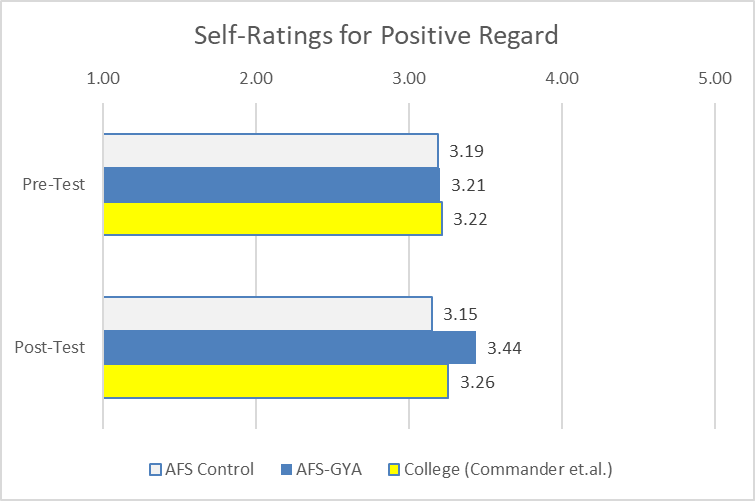
Perhaps the strongest improvement was observed in “Positive Regard” (the degree to which one withholds judgements about situations or people that are new or unfamiliar; Kozai Group, 2011). Here we can compare the pre- and post-test self ratings for the AFS GYA group, the Control group, and with the result from a study by Nannette Evans Commander, Wolfgang F. Schloer, and Sara T. Cushing (2) for college-level students enrolled in international virtual exchanges who took the same survey in a pre- and post-test comparison.
As the chart below shows, while all three groups start at roughly the same level, only the GYA Virtual Exchange participants show significant simple growth on this scale (p=0.001).
Simple T-test analysis can only compare the groups, however, and cannot control for other differences that might exist between groups, such as gender, experience with friends from other cultures, or parents’ socio-economic status. In particular, with a scale of this type, the pre-test score limits the potential for growth in any item. For example, a student who gave herself a pre-test score of 1 has the largest possible growth while one who gave himself a 5 has no room for growth at all. In this study, AFS wanted to assess the strength of the changes that could be attributed to the virtual exchange rather than the possible impact of other factors. For this reason AFS used logistic regression modeling that computes the odds of success or growth when the impact of these other factors is added to the equation.
With this regression model that controlled for the pre-test score and for other significant predictors, students who participated in the GYA program showed nearly three times greater odds of growth in both the overall Intercultural Effectiveness (IES) scale (p=0.022) and in the “positive regard” scale (p=0.030) compared to the control group. There is also good evidence for growth in “relationship development,” which showed 2.4 times greater odds for GYA program participants, but at a lower level of statistical significance (p=0.063). While this result does not meet the standard of 95% significance, it is certainly close to it.
| Overall Intercultural Effectiveness Scale |
The IES examines three dimensions of intercultural effectiveness: Continuous Learning, Interpersonal Engagement, and Hardiness. Continuous Learning comprises two sub-dimensions: Self-Awareness and Exploration. Interpersonal Engagement comprises two sub-dimensions: Global Mindset and Relationship Development. Hardiness comprises two sub-dimensions: Positive Regard and Resilience. An overall IES Score is generated by combining the results of the above six dimensions. |
288%, 98% statistical certainty |
Positive Regard
|
The degree to which one withholds judgements about situations or people that are new or unfamiliar.
|
275%, 97% statistical certainty
|
Relationship Development
|
The extent to which one is likely to initiate and maintain positive relationships with people from other cultures.
|
240%, 94% statistical certainty
|
After completing the program, students were prompted in the final survey to reassess some of the attitudes and communication behaviors they held before the GYA exchange, and to comment on the specific areas where they felt they learned the most. From the analysis of these responses, AFS found that GYA students noted that their cross-cultural communications skills had not been as strong as they had initially assumed. They also commented frequently about having developed friendships with students from other countries through this program and in many cases were planning to stay connected with these new friends.
What’s Needed for a Successful Virtual Exchange?
According to the study, some of the key elements for a successful virtual exchange, and demonstrated by the AFS Global You Adventurer program, include its highly diverse and multilateral cohorts and the combination of activities that participants can do on their own time in between live facilitated dialogue sessions. Such program structure is set up to grow students’ global competence and was well received by participants, who reported an enriching and transformative experience. Each cohort co-created community participation agreements to ensure an intentional, brave space for learning from each other.
GYA program participants grew particularly on measures of positive regard, relationship development, and cross-cultural communication. Accordingly, short-term virtual exchange programs may choose to focus on a particular dimension of global competence that they wish to develop among their cohort groups. Students in the 14- to17-year-old age group may especially benefit from repeated reinforcement of key ideas and time to embed these through practice.
Many students reported forming friendships, noting that they found their interactions with others particularly enriching. This shows that even within a short timeframe, virtual exchange participants can enhance their relationship development. However, some participants also desired more opportunities to interact. AFS GYA and other virtual exchange programs which have a similar asynchronous course-based structure should ensure as many opportunities for contact as possible are incorporated into course activities, including informal time to chat and connect. While not everyone will have an opportunity nor interest in in-person exchange or study abroad, virtual exchange can provide a unique experience for diverse learners to expand their alternatives in global learning that clearly have a meaningful impact.
Notes
(1) Copyright © 2023 World Wide Web Consortium. https://www.w3.org/Consortium/Legal/2023/doc-license
(2) Commander, N. E., Schloer, W. F., & Cushing, S. T. (2022). Virtual exchange: a promising high-impact practice for developing intercultural effectiveness across disciplines. Journal of Virtual Exchange, 5, 1–19. https://doi.org/10.21827/jve.5.37329
(3) Kozai Group. 2011. The Intercultural Effectiveness Scale (IES): Instructor’s Guide. Available: https://www.kozaigroup.com/wp-content/uploads/2015/09/IES_Guide.pdf