I. Background and methods
In order to better understand the potential of online community-based learning for fostering global citizenship capacities in an increasingly interconnected and digitized world, the study examined data from three institutions in the United States who moved their in-person community-based global learning programs to the fully online modality during COVID school closures. College students in the sample worked with a range of community partners, for example a non-profit working with migrants in Mexico and a healthcare clinic in Ghana. And common projects included activities like organizing virtual conferences, creating digital archives, and applying for grants.
The study utilized data from the Global Engagement Survey (GES) (n = 187) collected primarily during the summer of 2020. The GES is a pre-/post mixed-methods tool which assesses student global learning related to three components: cultural humility, global citizenship, and critical reflection (Hartman et al., 2015). Zoom interviews with alumni (n = 23) were conducted during the summer of 2023, which was one to three years after program completion. More details about this study can be found in the full dissertation.
II. Findings and analysis:
As a purpose-driven study, the aim of this research was to produce results and recommendations for effective and inclusive teaching and learning practices. Thus, analysis included disaggregating data by key demographic factors including first-generation to college status. And mixed-methods analysis found that first-generation students participating in an online community-based global learning program reported greater gains in learning than their non-first-generation peers
Quantitative analysis
Independent-sample t-tests revealed a statistically significant difference in mean pre- and post-survey scores where p ≤ .039 between first-generation students (n = 40) and non-first-generation students (n = 140) on 7 of the 8 survey scales. The chart below details mean change scores (mean pre-survey score subtracted from mean post-survey score), standard deviations, and p-values for the 8 survey scales.
Non-First Gen and First Gen independent t-test results on the 8 scales
|
|
Openness
to Diversity
|
Cultural
Adaptability
|
Civic
Efficacy
|
Political
Voice
|
Conscious
Consumption
|
Global Civic
Responsibility
|
Human
Rights Belief
|
Critical
Reflection
|
|
Non-First Gen
Mean Change Score
|
.14
|
.08
|
.25
|
.25
|
.20
|
.19
|
.0018
|
.12
|
|
Non-First Gen SD
|
.365
|
.361
|
.452
|
.620
|
.340
|
.478
|
.355
|
.313
|
|
First Gen Mean
Change Score
|
.38
|
.29
|
.59
|
.48
|
.36
|
.42
|
.08
|
.29
|
|
First Gen SD
|
.389
|
.381
|
.461
|
.593
|
.406
|
.511
|
.198
|
.386
|
|
p
|
≤.001
|
=.002
|
≤.001
|
=.039
|
=.013
|
=.010
|
=.214
|
=.003
|
Thus, quantitative analysis found that after participating in an online community-based learning program, first-generation students reported greater learning gains compared to their non-first-generation peers.
Student demographics
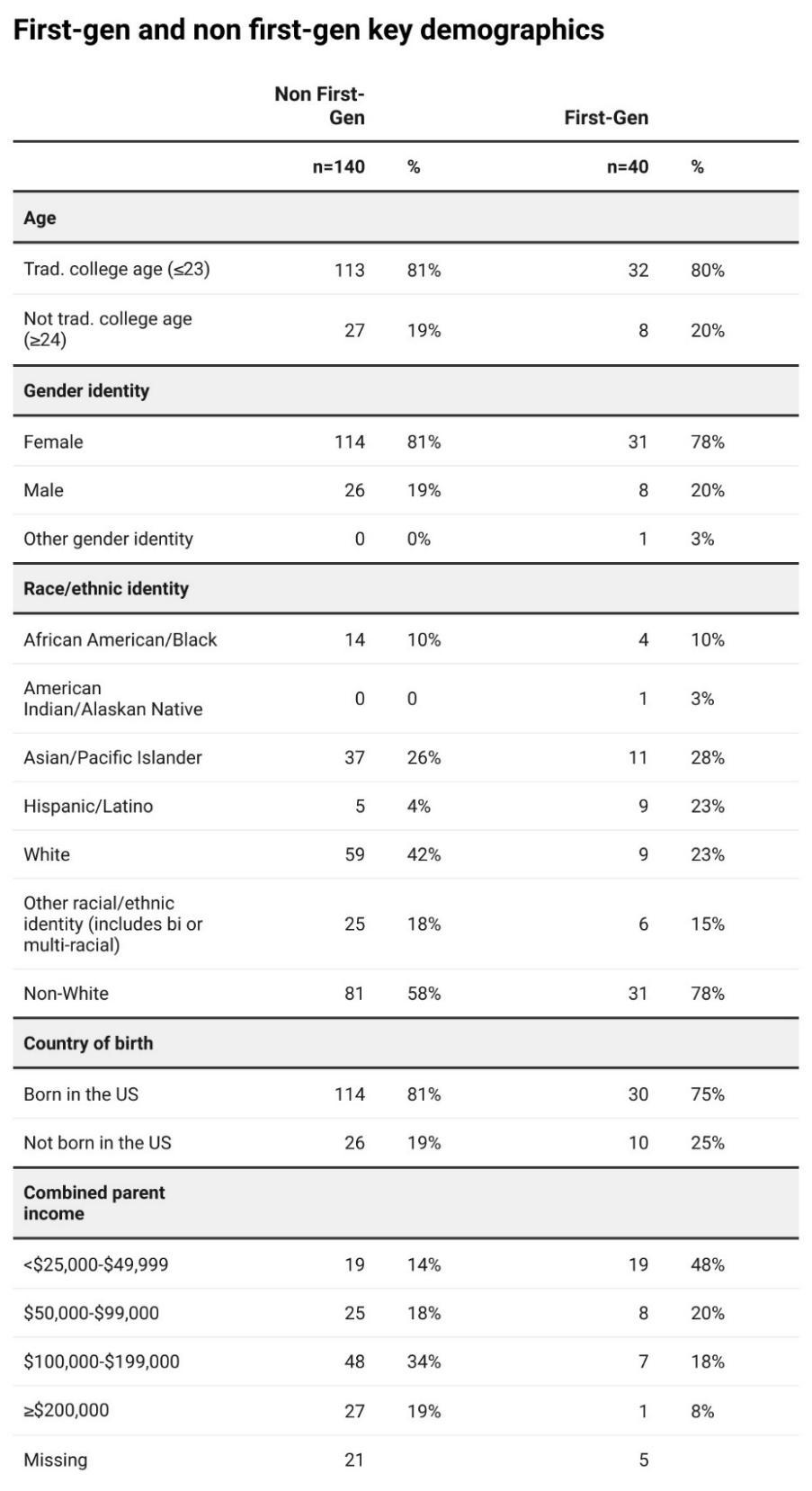
Qualitative analysis of survey and interview data sheds light on the quantitative findings above. Qualitative analysis suggests that first-generation students who are more likely to be non-White, born outside of the United States, and low-income than non-first-generation students in the sample brought attitudes and lived experiences—openness to an unfamiliar learning environment, intrinsic motivation for experiential learning, intercultural collaboration, and experience with resisting systems of oppression—which facilitated their learning. An overview of student demographics is presented in the table below.
Qualitative analysis
This article focuses on how one particular attitude—a strong sense of openness and curiosity—may have been a way that first-generation students sustained motivation despite uncertainty and barriers that came with participating in an unfamiliar learning environment in the middle of a global pandemic.
Non-first-generation students: Online as an ok alternative to the “real” experience
Many non-first-generation students said that they saw the online program as preparation for future in-person learning experiences like study abroad, internships, volunteerism, or community-based learning. These students viewed the in-person experience as “real” and the online as an ok alternative given the circumstances of not being able to travel or have in-person contact during the pandemic. It was common for non-first-generation students to state things like, “If this was an actual program, I would have probably been traveling around India and the survey that I ended-up creating would have gone out far earlier.” It is possible that non-first-generation students had fixed ideas from their family and friends about what their college experience was supposed to look like—internship sophomore year, study abroad junior year, apply to graduate school in their senior year. In fact, one non-first-generation student said the only reason they participated in the online program was that the competitive summer internships in their field of Architecture did not happen during the pandemic.
First-generation: Online as a great opportunity
What is most revealing is that no first-generation students in the interview sample expressed the view that the online program was an ok alternative to the “real” experience. Instead interview data revealed that first-generation students overwhelmingly viewed the online program as a great opportunity, such as the student who said, “I pray that such opportunities could be available for other people because it was beneficial for me. I would love to do more of this, and it exposed me to a lot of knowledge and skills.” It seems that first-generation students were less stuck in ideas about “how things are supposed to be” than their non-first-generation peers, and more willing to engage open-mindedly in a learning experience that was not what they expected.
Research in the field of positive psychology shows that people who display mindsets such as openness and curiosity are better able to explore, take risks, and trust others; therefore, openness and curiosity are agents of personal growth and learning (Neff et al., 2007; Seligman & Csikszentmihalyi, 2000). Thus, approaching the unfamiliar and perhaps uncomfortable experience of online community-based learning with an open and curious mindset may have spurred greater learning for first-generation students compared to their non-first-generation peers.
III. Recommendation: Guide students to sustain uncertainty
a. Guide students to reflect on their strengths
This analysis suggests that first-generation students came into the online global learning experience with attitudes and lived experiences that helped them to thrive; however, students may not be consciously aware of how their lived experiences can be strengths. This can be especially true for students who are traditionally marginalized in higher education, like first-generation students, who have been told their whole lives that their background (e.g., not having family to guide them in the college process or not speaking English as their first language) is solely a challenge to overcome rather than also an asset. I suggest that educators provide concrete language and a framework for students to think about how their lived experiences are strengths, such as Yosso’s (2005) theory of cultural wealth, which could be useful for all students but especially for those who are traditionally marginalized. Further, educators should provide a way for students to reflect on their strengths through writing and discussion; an example is Worcester Polytechnic Institute’s evidence-based asset mapping exercise.
b. Introduce mindfulness
This study found that an open and curious mindset in first-generation students fostered greater learning gains while engaging with the uncertain experience of online community-based learning during a global pandemic. Research supports that practicing mindfulness exercises, such as meditation or walking in nature, can help individuals feel a sense of calm and safety that allows them to be open to new experiences as well as recognize joy amidst uncertainty (Fredrickson, 2009; Neff, 2011). Thus, I suggest that introducing students to mindfulness exercises may help cultivate an open and curious mindset and identify joy in educational and life experiences that are new and uncertain. Motivated by my study findings, I have developed a resource for global educators interested in teaching mindfulness in their own classrooms: Mindfulness exercises to prepare for community based global learning.
References
Fredrickson, B. (2009). Positivity: Top-notch research reveals the 3-to-1 ratio that will change your life. Harmony.
Hartman, E., Lough, B., Toms, C., & Reynolds, N. (2015). The beauty of global citizenship: The problem of measurement. In J. Friedman, V. Haverkate, B. Oomen, E. Park, & M. Sklad (Eds.), Going glocal: The theory, practice, evaluation, and experience of education for global citizenship (pp. 125–145). Drukkerij Publishing.
Neff, K. (2011). Self-compassion: The proven power of being kind to yourself. Harper Collins.
Neff, K. D., Rude, S. S., & Kirkpatrick, K. L. (2007). An examination of self-compassion in relation to positive psychological functioning and personality traits. Journal of Research in Personality, 41(4), 908–916. https://doi.org/10.1016/j.jrp.2006.08.002
Seligman, M. E. P., & Csikszentmihalyi, M. (2000). Positive psychology: An introduction. American Psychologist, 55(1), 5–14. https://doi.org/10.1037/0003-066X.55.1.5
Yosso, T. J. (2005). Whose culture has capital? A critical race theory discussion of community cultural wealth. Race Ethnicity and Education, 8(1), 69–91. https://doi.org/10.1080/1361332052000341006